About the CV
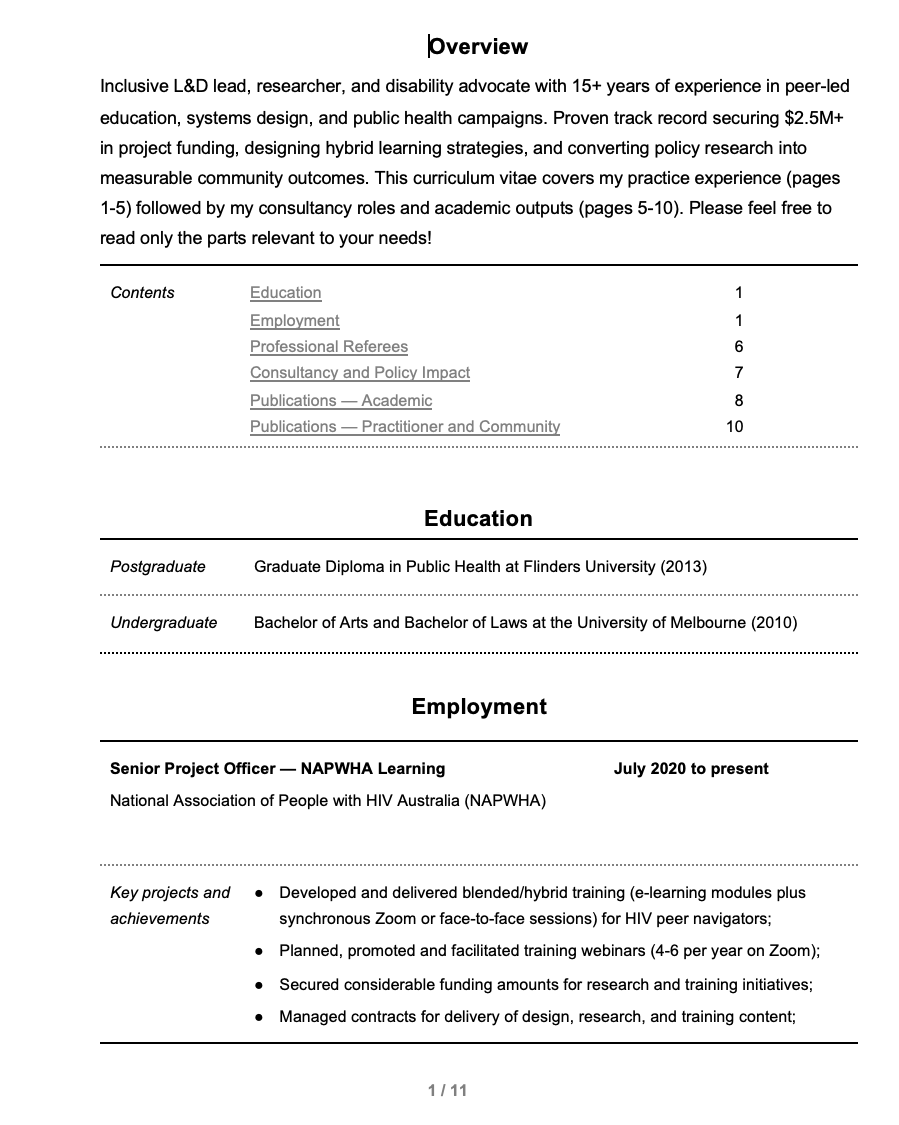
I don’t write two separate CVs — one for academia and another for practice — because I am a ‘pracademic.’ It’s important that academia can see and value my practice experience and vice versa. So my CV is a hybrid creature. And I’m okay with that!
Please use the links on the table of contents to zoom about the document and discover what you need to find in it.
Table of Contents
Employment timeline
Senior Project Officer — NAPWHA Learning
National Association of People with HIV Australia
2000-present
Research Officer — Major Reforms
Centre for Social Impact
2016-2020
Research Officer — What Works and Why (W3)
Australian Research Centre in Sex, Health and Society
Senior Project Officer — Multicultural Health and Support Service
Centre for Culture, Equity and Health
Education timeline
PhD Candidate (discontinued)
Australian National University
2016-2026
Endeavour Fellowship
Université de Montréal
2019
Graduate Diploma in Public Health
Flinders University
2013
Frequently Asked Questions
What is a pracademic, anyway?
A pracademic is a practitioner academic, someone who has one foot in scholarly life and one foot in everyday work practice. Does this mean I have commitment issues? Not at all — I’m committed to achievement in both fields, even though sometimes it’s a lot to manage.
What do scholarly publications even mean?
Scholarly publications are the principal key performance indicator for academics. I don’t list them on my CV for bragging rights — they are the first place an academic employer will look to understand my work history and potential. Yes, they are written in scholarly language and no, that isn’t always user-friendly.
What about your personal life?
I’ve written about being a queer and nonbinary person with disability that includes AuDHD. Autism gives me a passion for in-depth inquiry, while ADHD keeps me on the move, scanning the horizon for interest, challenge, novelty, urgency, passion. (Read about the INCUP model here.)
Why did you discontinue your PhD?
I was diagnosed with bipolar type 2 in the second year of my PhD and this caused disruption lasting for several years. My scholarship ended and I went back to full-time work, which was great for my mental health but created a real struggle finding time for study. I have discontinued that program but I haven’t given up on getting a PhD (purely for the gender neutral pronouns).